



* Rolls-Royce presents Project Nightingale, the first Coachbuild Collection
* Name derived from Le Rossignol, the name of the designers’ and engineers’ house at Henry Royce’s French Riviera estate, which means ‘the nightingale’
* Draws inspiration from high-speed experimental ‘EX’ Rolls-Royces of the 1920s
* Constructed using the Rolls-Royce Architecture of Luxury aluminium spaceframe
* Sheer, monolithic aesthetic inspired by the discipline of Streamline Moderne design
* Project Nightingale is a production concept, global testing and validation programme commencing this summer
* Available by invitation only, offered to clients with a deep affinity for Rolls-Royce design
* Limited to 100 client motor cars worldwide, with deliveries beginning from 2028
Goodwood, West Sussex : “Some of the most discerning Rolls-Royce clients in the world asked us for our most ambitious work. We responded by bringing three things together that have never coexisted within our brand: the complete design freedom of coachbuilding, our powerful, near-silent all-electric powertrain, and a uniquely potent yet serene expression of open-top motoring – an experience that only this technology makes possible. Achieving this required the same audacious mindset that drove our co-founder, Sir Henry Royce, to create his radically different experimental ‘EX’ motor cars of the 1920s. Project Nightingale shares the spirit of those landmark projects and is the most extravagant expression of what Rolls-Royce is capable of today.”
Chris Brownridge, Chief Executive, Rolls-Royce Motor Cars
“Project Nightingale is built on the design principles that define this marque at its most compelling – grand proportions, absolute surface discipline, and a clarity of line that rewards the closest attention. And yet, it takes them somewhere entirely new. For me, this landmark motor car feels both inevitable and completely unexpected, and it will shape everything that follows.”

Domagoj Dukec, Director of Design, Rolls-Royce Motor Cars
Rolls-Royce Motor Cars presents Project Nightingale, a Coachbuild Collection. Named after Le Rossignol, French for ‘the nightingale’, and the name of the designers’ and engineers’ house near Henry Royce’s winter home on the Côte d’Azur, this extraordinary production concept is an open two-seat motor car that introduces a dramatic new expression of Rolls-Royce design.
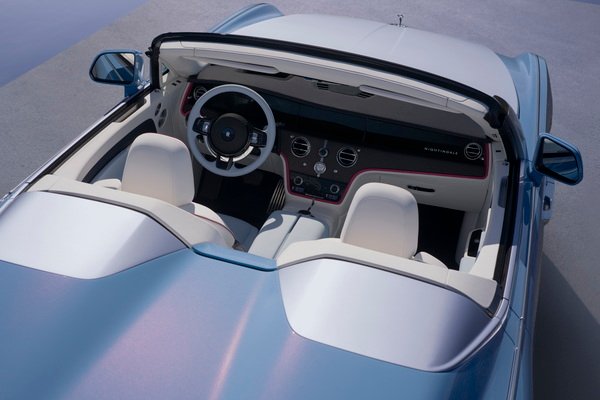
Defined by grand proportions and underpinned with a fully electric drivetrain that delivers a uniquely silent open-top experience, Project Nightingale draws on the glamour and confidence of the 1920s and 1930s while remaining entirely of its time. Its creative vision is fully resolved – the small number of design details that remain demand entirely new manufacturing techniques that are currently under development. Only 100 examples will be created for sale, each coachbuilt by hand at the Home of Rolls-Royce at Goodwood.

Project Nightingale and the Coachbuild Collection programme have been crafted for aesthetes – individuals for whom beauty is both observed and lived. These clients are connected by a shared conviction in the primacy of Rolls-Royce design, the value of the most considered motor cars in the world, and a deep appreciation for experiences that only Rolls-Royce can offer. Clients are already participating in a multi-year programme of gatherings and moments curated by Rolls-Royce, immersing them in the creative and technical formation of their motor car, as well as private events in the world’s most desirable destinations.
STREAMLINERS, SPEED, AND THE DISCIPLINE OF SHEER, MONOLITHIC BEAUTY
Project Nightingale has been conceived for the uniquely design-literate clients at the heart of the Coachbuild Collection programme: people for whom a perfectly resolved surface is as compelling as the glamour of driving an open-top Rolls-Royce. The motor car’s aesthetic is inspired by the principles of Streamline Moderne design from the late Art Deco era, wherein precise lines and uninterrupted forms are more powerful than ornament. In that spirit, when conceiving Project Nightingale, Rolls-Royce creatives embraced sheer, monolithic volumes.

Another point of inspiration for Project Nightingale is Rolls-Royce’s experimental motor cars of the 1920s. Known as ‘EX’ models and fitted with red badges – which Project Nightingale is also equipped with – these are some of the rarest and most desirable motor cars in the marque’s history. Two of these prototypes were a particular focus: 16EX and 17EX.
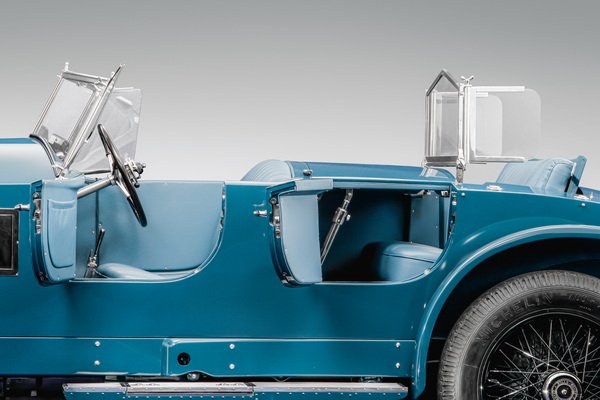
These motor cars were created in 1928, at the height of the Jazz Age, just three years after the Art Deco movement was given its name. Henry Royce and his engineers cloaked two powerful Phantom chassis in lightweight aluminium bodies to achieve a new top speed for Rolls-Royce. 16EX and 17EX were designed to reach in excess of 90 miles per hour, and their torpedo-shaped form perfectly captured the audacity of Royce’s ambition: an imposing overall scale; a long bonnet; a shallow windscreen; and a snug, enveloping cabin with driver and companion set deep inside.
From these foundations, Coachbuild designers distilled three principles that directly inform Project Nightingale.
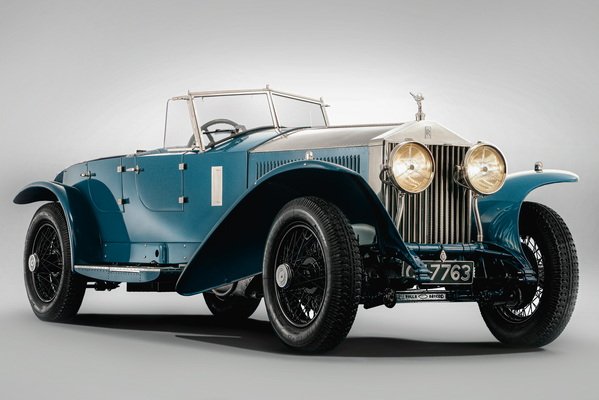
‘Upright to flowing’: the Pantheon Grille’s commanding vertical gesture transitioning into a long, graceful rear; ‘Central fuselage’, defined by a single unbroken hull line running from front to rear; and ‘Flying wings’: sculptural volumes that create tension across the overall form and pull the eye towards the rear. Project Nightingale channels these principles in a way that is both familiar to those fluent in the Rolls-Royce story, yet unapologetically contemporary and unlike anything before it.
FRONT ELEVATION
At 5.76 metres in length, Project Nightingale is almost exactly the same length as the marque’s flagship saloon, Phantom, yet devoted entirely to a two-seat convertible form. The drivetrain transforms the front elevation entirely: with no requirement for the large cooling intakes needed for an internal combustion engine, designers achieved unprecedented expanses of uninterrupted surfacing between the outermost edges of the wings and the Pantheon Grille.
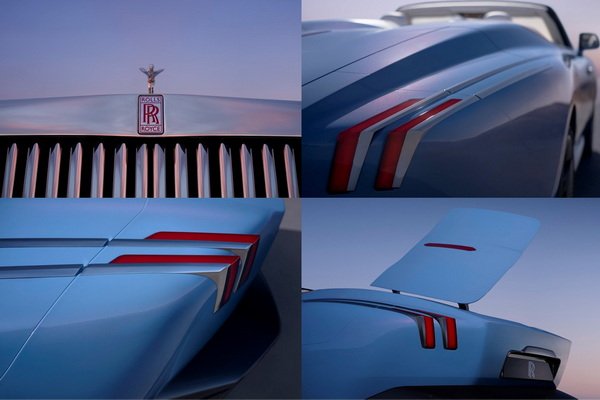
The grille itself is a bold interpretation of one of the most recognisable icons in luxury. Its generous surround – almost a metre in width – appears to be carved from a solid block of stainless steel, with 24 vanes set deeply within it. The Spirit of Ecstasy figurine is integrated on top of the grille in a subtly recessed section, its lines flowing backwards and dissolving into the bonnet, as though the figurine is moving at speed through water, and the metalwork is parting gently around her.
Beneath the grille, a structured section widens at 45 degrees from each lower corner before dropping down vertically, from which a carbon fibre apron projects forward, traced by an elegant chrome belt. This creates the effect that the grille is presented on a structural plinth, recalling the great Art Deco skyscrapers whose uppermost decorative floors are supported by solid geometric forms beneath them.
At the outermost edge of the wing is Project Nightingale’s most progressive statement: slender, vertically orientated headlamp assemblies. This treatment is emphasised with polished stainless-steel bands that run the full length of the motor car from the bottom of the headlamps all the way to the tail lamps.
TORPEDO ‘CENTRAL FUSELAGE’ IN PROFILE
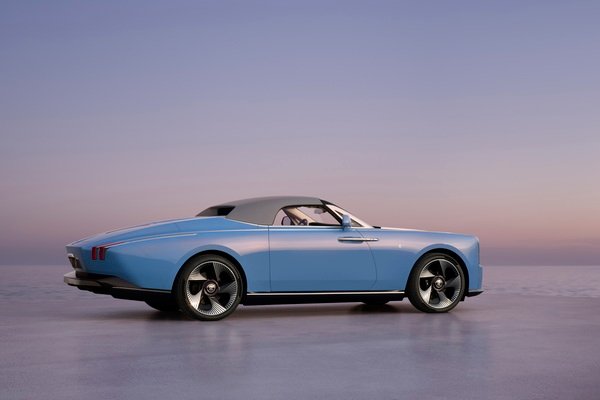
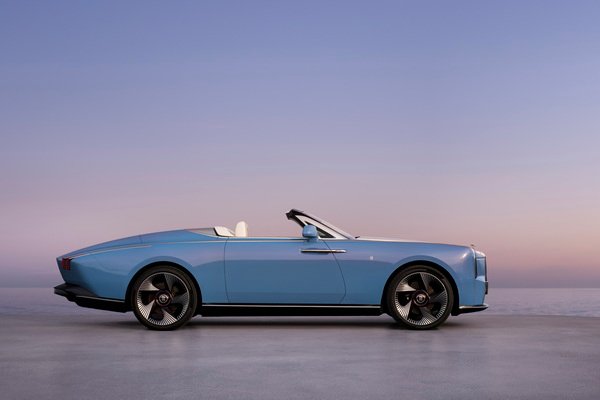
In profile, the full impact of Project Nightingale’s driver-oriented, torpedo-shaped design is revealed. An expansive bonnet gives way to the dramatically raked windscreen, framed on each side by a stainless-steel form housing a delicate quarterlight window, inspired by the Rolls-Royce Phantom Drophead Coupé. Behind it is a compact cabin for two, set deep within the body, before the rear deck falls and tapers towards a dramatically low trailing edge. This is a motor car that is almost entirely bonnet and tail, its two-seat cabin an intimate counterpoint to the grandeur of the volumes surrounding it.
A single hull line runs continuously along Project Nightingale from front to rear, inspired by the line that separates a yacht’s hull from its superstructure. It begins at sculpted ‘Pinnacles’ on the front wings – a subtle reference to heritage Rolls-Royce designs – before flowing uninterrupted to the trailing edge. Set intentionally high, it creates the sensation of being enveloped deep inside the motor car. An upswept volume behind the headrests rises like a turned collar, cosseting driver and companion against the elements, integrating the height of the headrests into the sculpture of the motor car itself.
Beneath, a progressive negative sculpture in the lower bodyside deepens the impression of a central fuselage, balanced by a solid carbon fibre sill that makes an understated historical reference to the running boards of prominent heritage Rolls-Royce motor cars.
To add restrained decoration to the rear of the motor car, a second lower polished stainless-steel band is introduced just behind the centre of the rear wheels, its position and proportion recalling the gentle white water of a sailing yacht’s wake.
Significant development has been focused on the surfacing, ensuring that Project Nightingale appears to have been carved from a single, solid billet. To minimise visual noise, engineers developed a handle for the coach doors that incorporates a hidden lock mechanism and a discreetly integrated indicator lamp. The Rolls-Royce ‘Badge of Honour’ is also distilled into an elegant stainless-steel ‘Double R’ monogram, placed sparingly on each front wing and in the centre of the luggage compartment.
Against this serenity, 24-inch wheels – the largest fitted to a Rolls-Royce – strike a considered contrast. Their directional design is inspired by the propellers of a yacht viewed from beneath the waterline: forms that appear to be in continuous motion even when the motor car is stationary. The surface also includes subtle, machined stripes, creating the impression of wire wheel spokes moving at speed, while aluminium flakes within the black finish introduce a delicate sparkle as the wheel turns.